

This month, I interviewed an artist friend about how his mind works!
Welcome, Jack Foster. Jack and I met in an online children’s writing group.
RC: Tell us about yourself and your career – training, how did you start doing illustrations for kids?
JF: My dream was always to have a comic strip in the newspapers. As a young artist, Charles Schulz was my idol. I tried the newspaper syndicates for 25 years to get my own comic strip; however, I now have cabinets full of 25 years of rejection notices.
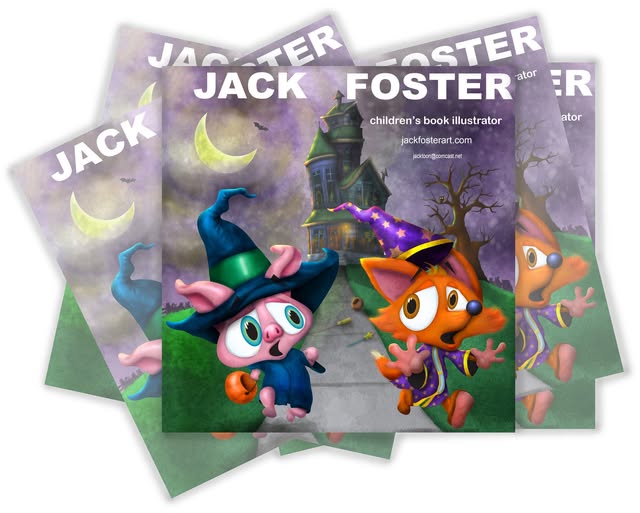
When I was 49 years old, my daughter, who had graduated from college and landed a job as a graphic designer, asked me, “Dad, are you still drawing on paper and sending your comics through snail mail?” I said that I was. She told me that I needed to go back to school and learn digital art. That’s what everyone was doing now.
So at 50 years old, I went back to college. I took classes in Photoshop and digital painting. Then I practiced for a year. When I thought my work had reached the point of being good enough to be published, I posted some of my digital work online, and a guy from Las Vegas, whom I didn’t even know, said that he knew a children’s book publisher looking for my style.
After he told me that, I remembered that a couple of my rejection notices that I had gotten over the years mentioned that my style would be better suited for children’s books. I never really thought that I was good enough to be an illustrator; I always thought of myself more as a comic strip/cartoon guy. But I sent that publisher some samples, and she signed me to a two-book contract.
So for 25 years, and hundreds of submissions, I tried to get into the newspapers, and my first try at children’s publishing, and I got in! Go figure.
RC: How many books have you been both author and illustrator?
JF: I recently went to an SCWBI conference, and an art Director from Source Books told me that if I can write stories to go along with my illustrations, she would be more than willing to take a look. Right now, all that I have done is illustrate. But there may be an author-illustrated book by Jack Foster, soon.
RC: How many books have you illustrated for other authors?
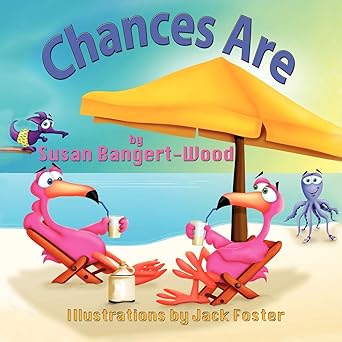
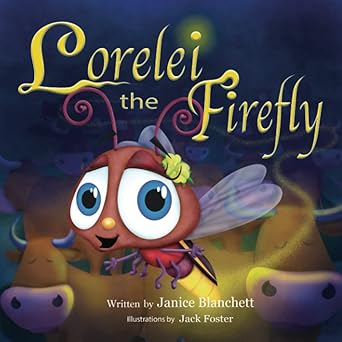
JF: I started illustrating children’s books in 2009. Right off the bat, I was working for four small publishers. At that time, I illustrated about 90 children’s books.
However, in 2020, COVID knocked three of those publishers out of business. Since then, I have been working primarily for self-publishing authors. And I have illustrated another 70 books.
So in total, I have illustrated close to 170 published children’s books.
RC: What art notes/guidelines do you want from the author/ editor?
JF: I like basic information, number of illustrations, if they are full page, and the size of the book. Other than that, I prefer minimal notes.
Of course, if people want the character to have a certain look, like the color of hair, or eyes, I am very accommodating. As far as composition and colors, I feel that as an experienced artist, I can contribute a more professional-looking illustration without a micro-managing author.
Of course, if they see my sketch and realize that it is way off the mark, I appreciate any input to get us on the same page. No pun intended. Lol!
RC: What feedback do you expect from editor/author?
JF: I have a system. I use a shared folder through a company, like Dropbox, where I add a sketch. The author/editor can look at the sketch and respond with revisions. If I don’t hear revisions in 48 hours, I begin the process of painting the illustrations. It is much easier to revise a sketch than a completed illustration.
I appreciate it when an author not only points out things that need to be changed, but also mentions things that they like. That helps me to focus on the direction of their vision.
RC: Any Pet Peeves authors should avoid?
JF: As I mentioned before, illustration notes are great, but please leave a lot of room for the artist’s interpretation and creativity. Avoid micro-managing; it not only zaps the illustrator’s joy and creativity, but it also affects the quality of the entire book.
Here is one of my own personal Pet Peeves: Have the manuscript completely edited and proofread. Don’t send the illustrator a draft of the manuscript. Send the complete manuscript, down to the last period. Subtle changes in the text may have a major effect on the composition.
And one last Pet Peeve: The illustrator storyboards the entire book. He knows that the final product must have a page number that is divisible by four. (for printing purposes) and that the last page must be left blank. Don’t interrupt the flow of the book and the final page count, by deciding to add a page.
RC: What’s next in your publications?
JF: I am working on a book about a dog that has gone to heaven. It is not from the POV of the owner who misses the pup, but rather from the dog looking down from heaven. It’s called Ruthie Pup, I’ll Always Love You.
I am also working on a story about a grandpa reading the Easter Story to his grandkids, and then telling them about Jesus’ second coming. It’s called: The Second Palm Sunday.
And, I’m also working on some artwork for a music CD that will be out in January. It is called Resurrection Rabbit’s Rise and Shine.
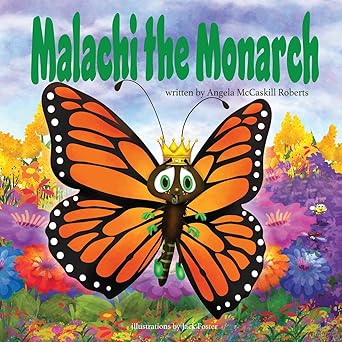
I’ve had 3 books released in the last 6 weeks. Stop Snoring Dad, Billie’s Balanced Lunch, and Malachi the Monarch. (all are available on Amazon)
Thanks, Jack, for the info on how to work together effectively. Authors, see more of Jack Foster’s work at his website.

Robin Currie is the author of more than 45 picture books. Her latest is Just Enough Room for Christmas, available now. https://www.amazon.com/Just-Enough-Christmas-Robin-Currie/dp/1680999737
No Comments