

From the first sentence, the writing must be well crafted, and the proposal handled with excellence. The editor or agent will know a lot about the writer just opening your email or opening the envelope. What type of care and attention have you given to the details of the proposal? Have you sent the proposal to someone who is interested in your topic? Are you an expert in your subject or connected to someone who is an expert?
The language of any book proposal has to be strongly written and persuasive.
Many writers are shocked to understand that a traditional publisher is going to spend somewhere between $50,000 and $100,000 on their idea. This dollar figure contains zero marketing dollars and involves editorial, design, sales and printing or manufacturing costs. This number includes a modest advance for the author such as between $5,000 and $10,000. As a writer you need to keep this $50,000 to $100,000 figure in mind because it will motivate you to use persuasive words for your book proposal idea. Are you worthy of such an investment? The only way to answer this question is with a resounding YES and persuasive words.
Like any good magazine article, the opening paragraph must promise the rest is as good as the first paragraph. It doesn’t have to be explicitly promised but it has to be compelling. Maybe you open with a startling statement or a statistic or a thought-provoking question. There is no single technique to open your book proposal. Normally it’s not something that a writer can instantly throw down on paper and have it been immediately right.

Sometimes the real beginning is several pages into your proposal, and you have to discard the first few paragraphs (or pages). You will have to begin with something called the “hook” and grab the reader with your topic.
Understand that editors and literary agents are busy people.
They probably don’t possess a lot of time to read your submission. Imagine they are reading your proposal in a spare moment between meetings or phone calls. Or just before they walk out of their office to close the door for the night, they take a few minutes to sit and read the recent submissions. Will your proposal stand up to such a reading test, or will it land instantly in the rejection stack? You must bulletproof your submission so it will withstand any casual reading test. Your writing or storytelling must capture their attention, so they are fixated on reading your entire proposal. It isn’t easy and will take a lot of crafting on your part to make such a proposal.
Also test your opening with people who are not in your immediate family and who will give you honest feedback. See if your first few sentences have enough interest that they want to read the rest of it. This person could be another writer or an expert in your subject area. You are wise to test the market with your opening. After they have read the opening paragraphs, ask several questions to make sure you begin with a bang.
If you take this step to test your paragraph and get feedback from others you will stand apart from the usual way that many writers operate. Instead of striving for excellence in their storytelling or communication, far too often writers are overly protective of their idea. They are concerned that someone is going to “steal” their concept. During my over 30 years in publishing, I have not seen any editor or literary agent “steal” another idea. Instead of worrying about this aspect, your challenge as a writer is to test your market and present the best possible book proposal.

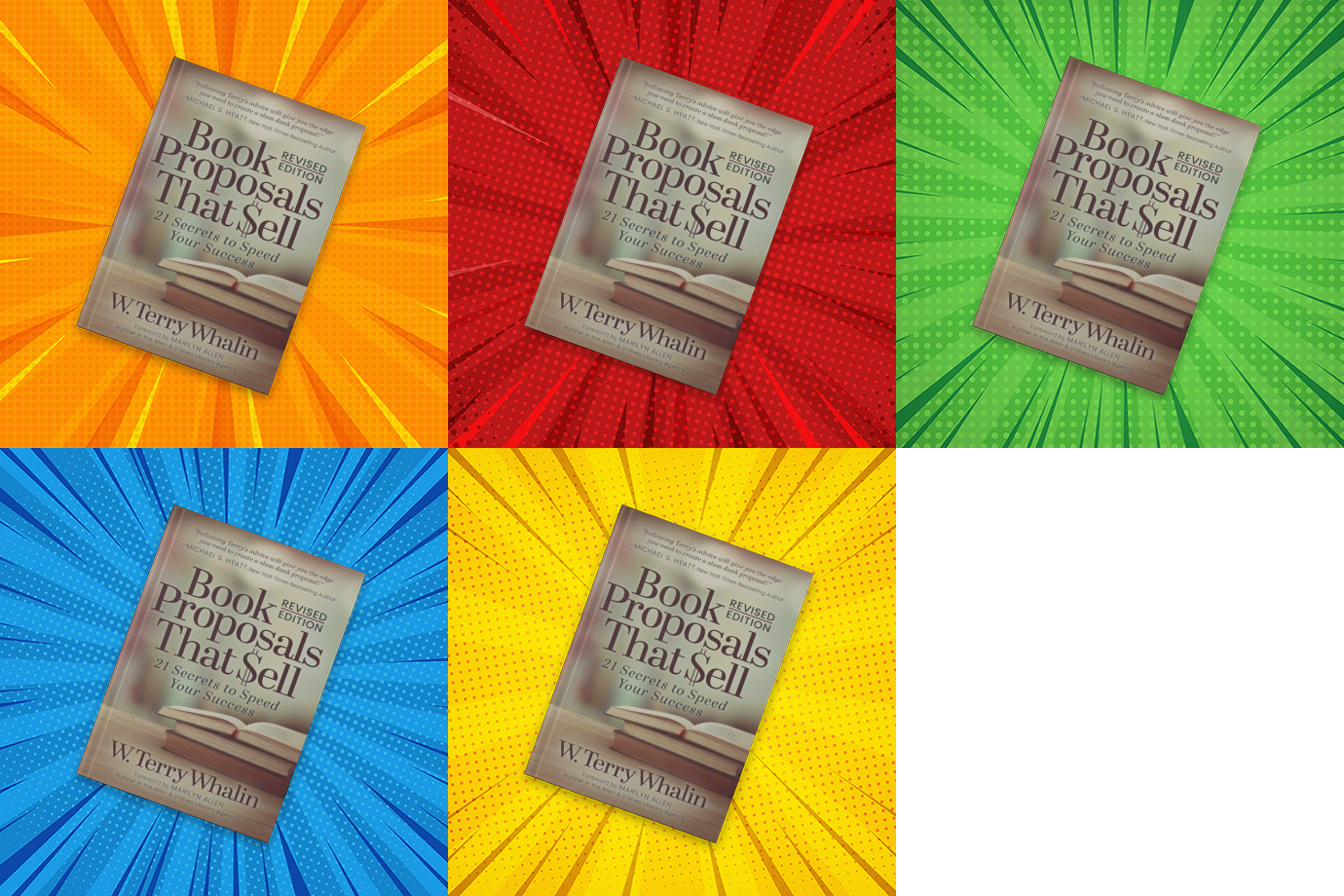
W. Terry Whalin, a writer and acquisitions editor lives in California. A former magazine editor and former literary agent, Terry is an acquisitions editor at Morgan James Publishing. He has written more than 60 nonfiction books including Jumpstart Your Publishing Dreams and Billy Graham. To help writers catch the attention of editors and agents, Terry wrote his bestselling Book Proposals That $ell, 21 Secrets To Speed Your Success. Get a free copy of his proposal book (follow the link). Check out his free Ebook, Platform Building Ideas for Every Author. His website is located at: www.terrywhalin.com. Connect with Terry on Twitter, Facebook, his blog and LinkedIn.

1 Comment
This was a helpful read. Testing your opening with others before submitting is such a practical tip that many writers overlook.